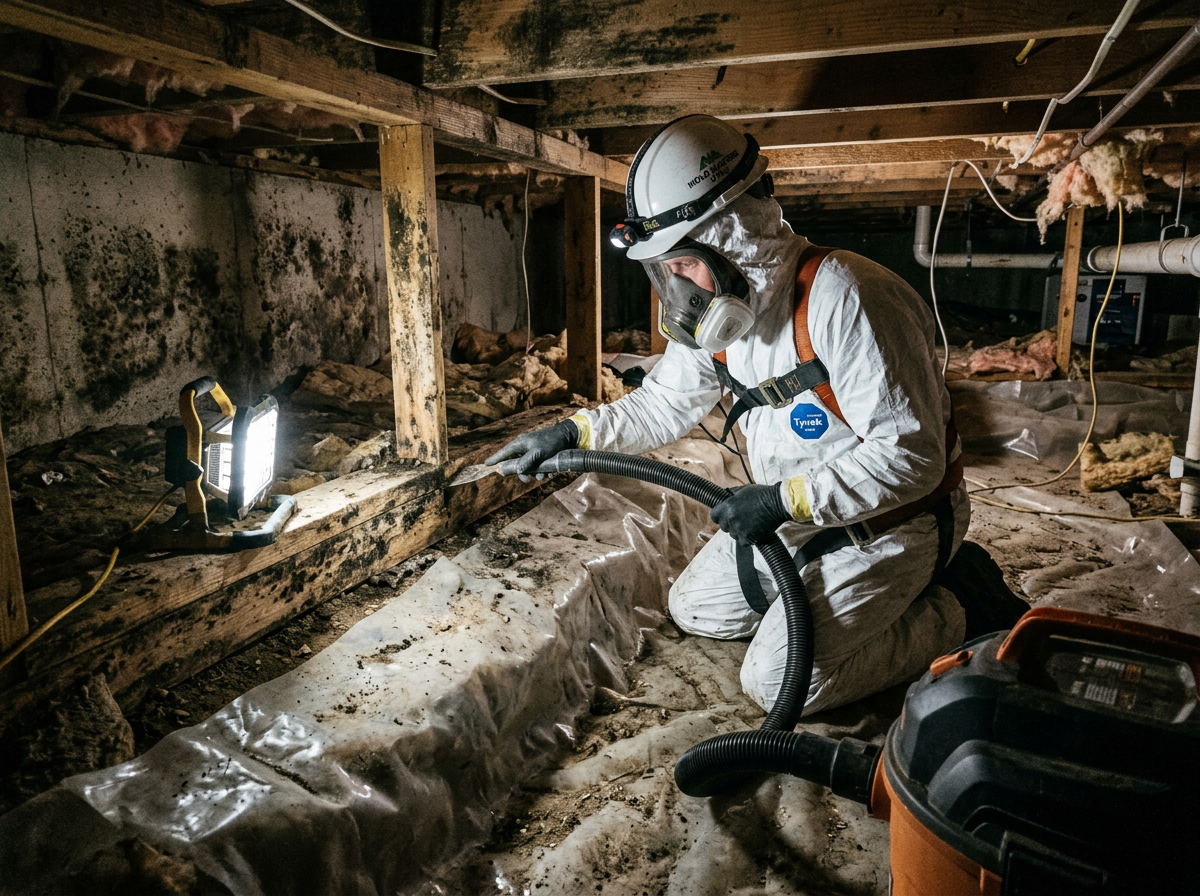
Crawl spaces in Springville homes often stay unheated through winter, allowing supply lines to freeze and burst without immediate notice. Growth appears on joists, insulation, and sub-floor sheathing once temperatures rise and moisture lingers. Technicians must first locate the leak, then establish containment at the crawl opening before any material is touched. Affected fiberglass batts and wet wood sections are cut out and bagged on site; solid joists receive surface treatment only after the water source is isolated.
Access remains the largest variable. Many Wasatch Front homes have crawl entries too narrow for full equipment, so crews work in sections with portable HEPA units and negative air directed outward. Vapor barriers that were never installed or have been torn allow ground moisture to re-wet framing every season. Replacement barriers are sealed to the stem walls and piers, but only after all visible growth is removed and the space is dried to consistent moisture readings below twenty percent.
Jobs fail when the original leak is left unaddressed or when insulation is simply sprayed and left in place. Post-remediation verification uses moisture meters and visual checks rather than air sampling unless requested. Limited headroom and soil conditions can extend drying times beyond a standard residential schedule, so homeowners should expect follow-up visits to confirm the space stays dry before any new insulation is added.
Technician insight
In Springville, the thing that catches most people out with Crawl Space Mold Removal is the unheated crawl under 1980s-2000s slab homes on the east bench. Frozen supply lines hidden behind insulation run undetected until spring, and once the line is fixed the vapor barrier is almost always missing or torn, so moisture returns the next winter.
East Springville Crawl Space
A homeowner noticed musty air near the laundry room. Inspection found a split PEX line under the master bath that had leaked for months onto the dirt floor. Crews removed saturated insulation, treated joists, installed a sealed vapor barrier, and coordinated line replacement. The space dried within four days and stayed dry through the following winter.
Crawl Space Mold Removal Services We Offer
✓Vapour Barrier Installation
New six-mil reinforced poly is sealed to stem walls and piers after growth removal to block ground moisture common beneath Springville homes.
✓Frozen and Burst Line Repair Coordination
Technicians isolate damaged supply lines in unheated crawls, then coordinate with licensed plumbers for permanent replacement before remediation continues.
✓Sub-Floor Treatment
Exposed plywood and joists receive antimicrobial application followed by HEPA vacuuming once wet insulation has been removed and the space dried.
✓Crawl Space Drying
Portable dehumidifiers and air movers are staged through existing access points to bring wood moisture content below twenty percent before any new materials are installed.
✓Insulation Removal and Disposal
Wet or contaminated batts are cut out in sealed bags and hauled away, preventing re-wetting from seasonal condensation on north-facing walls.
How it works
- 1
Source Identification
Technicians inspect supply lines, appliance hoses, and roof penetrations from inside the crawl to locate the active leak before any containment is built.
- 2
Containment Setup
Poly barriers and negative air machines are placed at the crawl entry to keep spores from entering living areas during material removal.
- 3
Material Removal
Affected insulation and visibly moldy wood sections are cut out and bagged on site; solid framing receives surface cleaning only.
- 4
Drying And Barrier Install
The space is dried to consistent meter readings, then a sealed vapor barrier is installed to limit future moisture from the soil.
Pricing
Final scope depends on crawl access difficulty, extent of affected materials, and whether plumbing repairs are needed at the same time; call for an inspection-based quote.