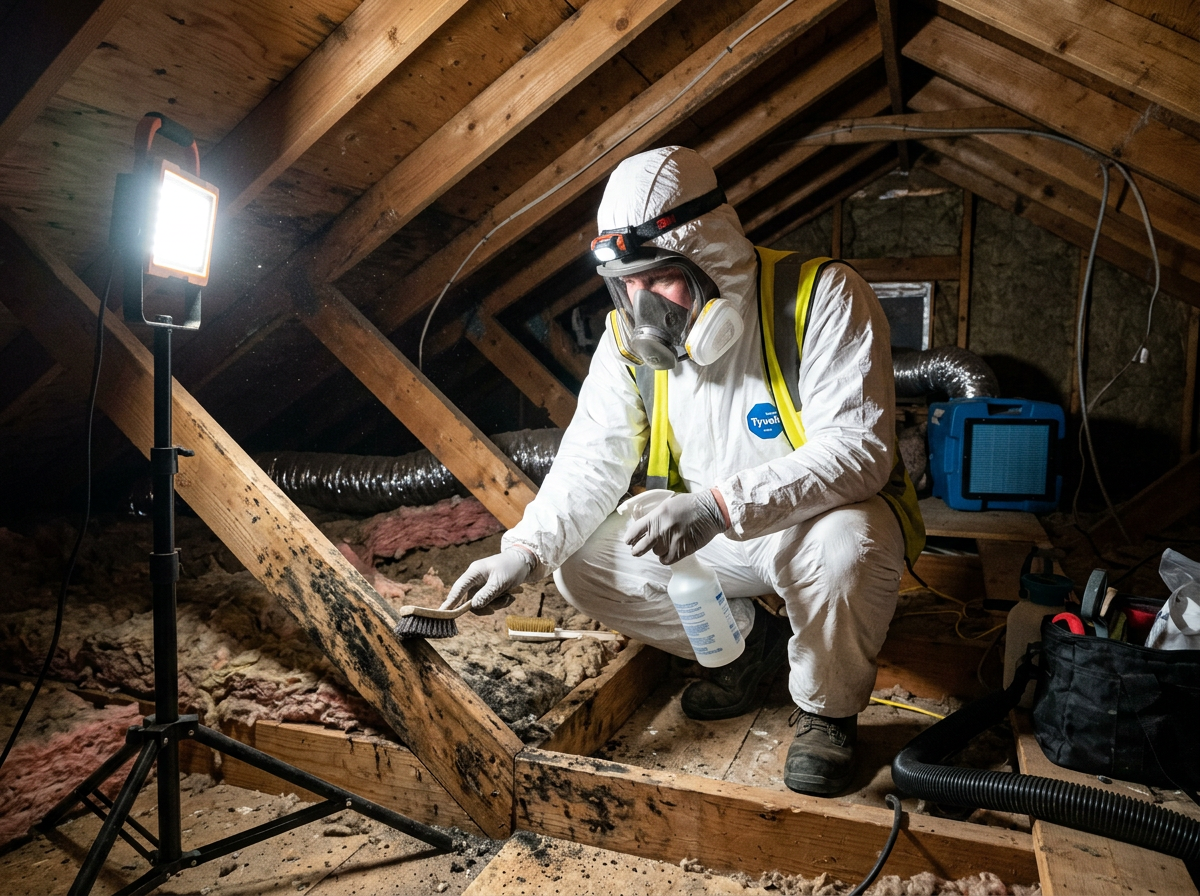
Utah mold almost always traces to a sudden or hidden water event rather than general humidity. A burst supply line behind a finished basement wall, a swamp cooler left undrained through winter, or an ice dam that lets meltwater track under roof sheathing can create hidden growth for months. Because the state is arid, these failures stay localized until someone opens the wall or the finished basement slab begins to feel cool and musty. Technicians begin every job by tracing the water path with moisture meters and infrared before any containment goes up.
Work proceeds in strict sequence. Once the leak source is confirmed and isolated, plastic sheeting and negative-air machines create a sealed workspace that prevents spores from migrating into living areas. Affected drywall, insulation, and base plates are cut out and bagged rather than treated in place. Exposed framing then receives HEPA vacuuming followed by an antimicrobial application only on surfaces that cannot be removed. The goal is physical removal of the growth, not surface masking.
Jobs fail when the water source is left uncorrected or when containment is skipped to save time. In tight modern homes, winter inversion can push condensation into north-facing closets even after the original leak is fixed, so dehumidification and ventilation checks are part of every clearance. Finished basements on slab hide slow leaks under carpet pad or behind baseboards for years; opening those areas fully is required before any treatment. Post-remediation verification uses visual inspection and moisture readings, not air sampling alone.
Technician insight
In Springville, the thing that catches most people out with Mold Remediation is finished basements poured directly on slab. A slow supply-line drip can run under the carpet pad for an entire heating season before anyone notices the musty smell, and by then the subfloor and bottom plates are already compromised. Opening those areas fully is the only way to stop the cycle.
Winter Swamp Cooler Leak in Springville Basement
A homeowner noticed a damp corner in a finished basement after leaving the swamp cooler undrained through a cold snap. Inspection found pooled water behind the baseboard and insulation saturated along two walls. Crews isolated the cooler drain, removed the wet drywall and insulation, applied negative air during removal, and dried the exposed framing before reinstallation. Moisture readings stayed within normal range at the final check.
Mold Remediation Services We Offer
✓Containment and Negative Air
Full plastic barriers and negative-air machines isolate the work zone so spores do not travel through HVAC or open living spaces during removal.
✓Affected Material Removal
Drywall, insulation, carpet, and base plates showing visible growth are cut out and disposed of rather than left in the structure.
✓Antimicrobial Treatment
EPA-registered products are applied only to exposed framing and concrete after physical removal to address any remaining surface spores.
✓HEPA Cleaning
HEPA vacuums and air scrubbers capture fine particles on all remaining surfaces before final clearance testing.
✓Post-Remediation Verification
Visual inspection plus moisture-meter readings confirm the area is dry and free of visible growth before barriers come down.
✓Source Identification and Repair Coordination
Technicians locate the mechanical failure—pipe, appliance hose, or swamp-cooler drain—and coordinate with plumbers or roofers so the moisture source is eliminated.
How it works
- 1
Source Location
Moisture meters and infrared locate the water event behind walls or under slabs before any demolition begins.
- 2
Containment Setup
Plastic sheeting and negative-air machines seal the affected area from the rest of the home.
- 3
Material Removal and Treatment
Visible growth is cut out, bagged, and removed; remaining surfaces receive HEPA vacuuming and targeted antimicrobial application.
- 4
Clearance and Drying
Post-remediation moisture checks and visual inspection confirm the space is dry before containment is removed.
Pricing
Final scope depends on the size of the affected area, depth of material removal required, and access conditions in finished spaces; call for an inspection-based assessment.